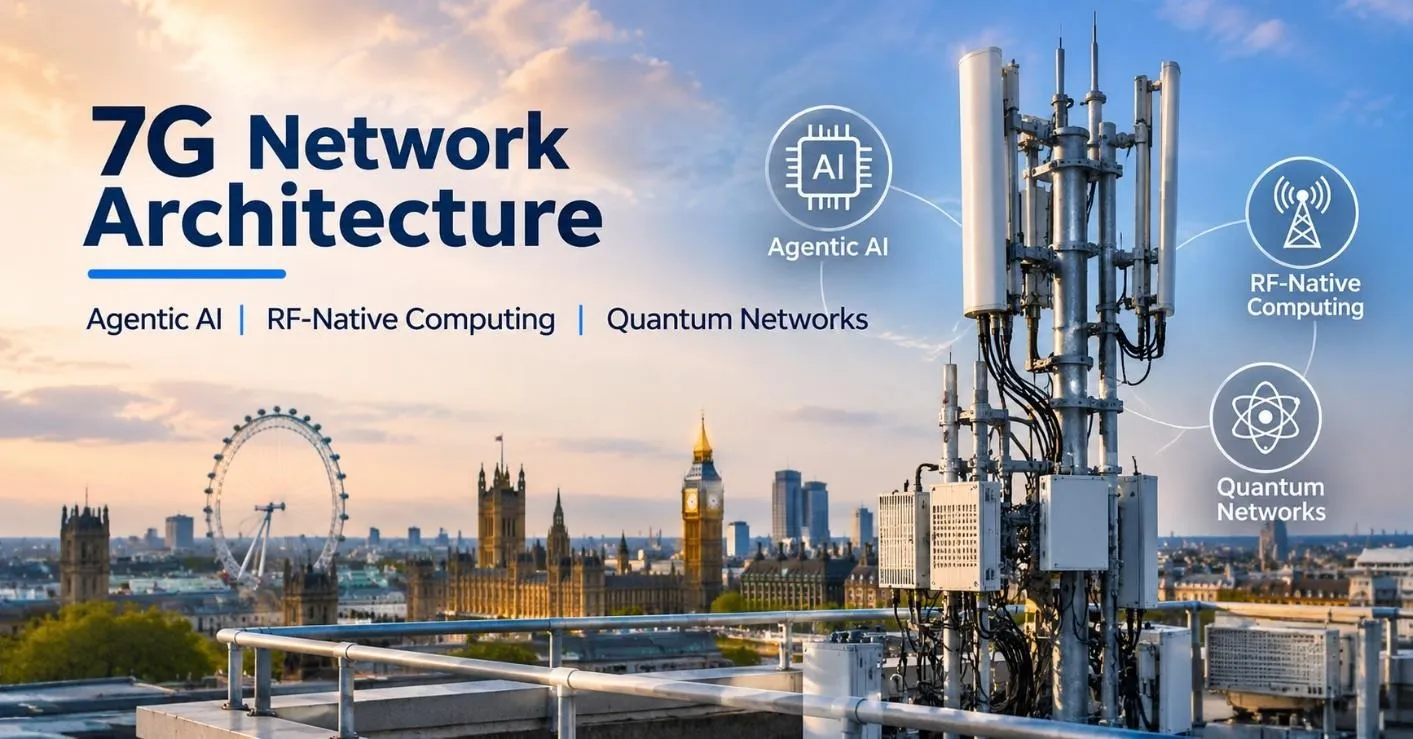
Mobile networks are moving towards greater automation, distributed processing and intelligent radio management. While 5G-Advanced continues to improve network performance and 6G development is progressing through international standards, researchers are already examining technologies that could influence mobile networks beyond 6G. So, now let us look into 7G Network Architecture Agentic AI, RF-Native Computing and Quantum Networks along with Accurate LTE RF drive test tools in telecom & RF drive test software in telecom and Accurate Mobile Network Monitoring Tools, Mobile Network Drive Test Tools, Mobile Network Testing Tools in detail.
A September 2026 research paper titled Will There Be a 7G? examines whether future communication systems will require a separate mobile generation or continue evolving through 6G. The study discusses agentic AI, RF-native computing, quantum-enabled networking and new methods of managing network resources.
These technologies remain research concepts. No formal 7G radio standard or commercial 7G network architecture has been defined.
7G Network Architecture and Distributed Processing
Current 5G networks use separate radio access, transport and core network functions. Cloud-native deployment allows network functions to operate across distributed computing infrastructure.
Future network architectures may extend this approach by integrating communication, computing and automated control more closely.
Instead of relying on centralised systems for every network decision, distributed processing could allow radio sites, edge servers and core network functions to respond to local traffic conditions.
For example, an edge computing node could process network measurements, identify congestion and recommend radio parameter adjustments without sending every measurement to a central management system.
Such architectures would require reliable interfaces, synchronisation and consistent control between distributed network functions.
Agentic AI for Automated Network Operations
Agentic AI refers to AI systems that can perform assigned tasks, evaluate results and select further actions within defined operating limits.
In mobile networks, AI agents could monitor radio performance, analyse faults and coordinate network optimisation activities.
A possible operating sequence would include:
- Collecting RSRP, RSRQ, SINR, throughput and latency measurements.
- Identifying abnormal network behaviour.
- Analysing possible causes, including interference or congestion.
- Recommending or applying approved network configuration changes.
- Measuring network performance after the adjustment.
Unlike conventional rule-based automation, AI agents could use historical measurements and current network conditions to select suitable actions.
However, automated configuration changes require strict controls to prevent service disruption. Operators would still need approval policies, rollback procedures and performance verification.
RF-Native Computing and Radio Signal Processing
RF-native computing is a proposed approach in which radio-frequency signals or hardware perform selected computing operations.
Conventional receivers convert RF signals into digital information before applying most signal-processing algorithms.
RF-native approaches investigate whether certain operations can be performed directly through analogue RF components, antenna structures or programmable electromagnetic surfaces.
Potential applications include beamforming, signal filtering, channel estimation and selected mathematical operations.
The main objective is to reduce processing requirements, energy consumption and communication delays.
However, RF-based computation introduces challenges involving noise, component variation, measurement accuracy and hardware calibration.
Practical deployment would require repeatable results under different frequency, temperature and signal conditions.
Quantum-Enabled Communication Networks
Quantum-enabled networking investigates how quantum technologies could operate alongside conventional communication infrastructure.
One possible application is quantum key distribution, which uses quantum states to support secure key exchange.
Other research areas include quantum networking interfaces, synchronisation and communication between quantum processing systems.
These technologies would not replace conventional RF communication. Instead, specialised quantum links could operate alongside existing fibre, radio and network control systems.
Technical challenges include signal loss, equipment requirements, distance limitations and integration with existing network security procedures.
Quantum-enabled networking should also be distinguished from post-quantum cryptography, which uses conventional computing systems and cryptographic algorithms.
Network Testing Requirements for Future Architectures
As these technologies develop, network testing will need to cover radio performance and automated network behaviour.
Traditional measurements such as RSRP, SINR, throughput, latency, packet loss and mobility performance will remain relevant.
Additional testing may include AI decision accuracy, configuration response time, processing delay, RF computing errors and network recovery after automated changes.
For agentic AI systems, engineers will also need to verify whether automated actions improve network performance without introducing new faults.
Conclusion
Research into 7G raises a technical question: which capabilities would require an entirely new mobile network generation rather than further improvements to 6G?
Agentic AI, RF-native computing and quantum-enabled networking offer possible directions, but their practical benefits must be demonstrated through engineering trials, performance measurements and reliable operation.
For now, 6G remains the next formally defined generation, with the IMT-2030 framework providing the basis for technical requirements and evaluation.
About RantCell
RantCell helps telecom operators, network engineers and businesses measure, monitor and improve mobile network performance using Android smartphones. From RF drive testing and indoor 4G/5G coverage analysis to continuous network monitoring and automated reporting, RantCell makes it easier to collect network KPIs, detect performance issues and make informed engineering decisions.
Whether you are evaluating network coverage, testing new deployments or monitoring network performance across multiple locations, our technical team can help you understand how RantCell fits your requirements. Also read similar articles from here.