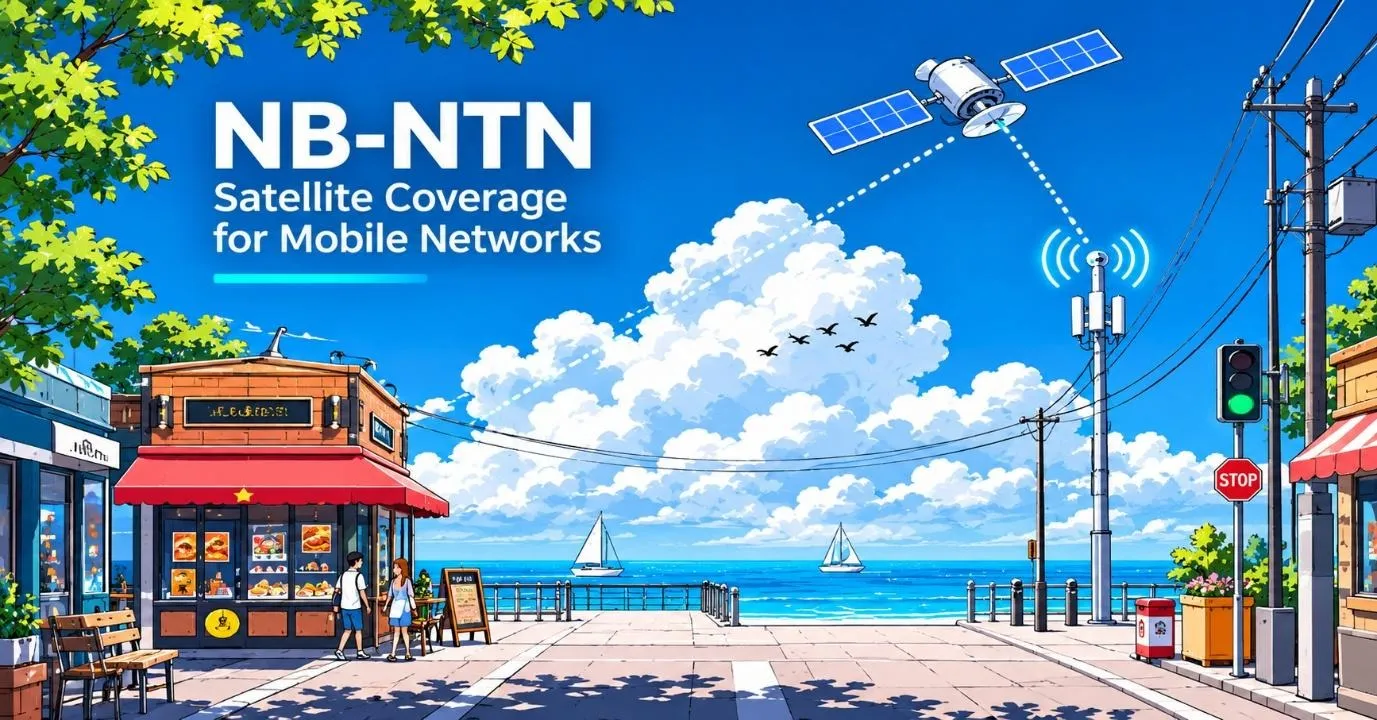
Mobile network coverage is mainly provided through terrestrial infrastructure, including macro sites, small cells and distributed antenna systems. However, extending cellular coverage to remote locations remains difficult due to limited infrastructure, power availability, backhaul connectivity and deployment costs. So, now let us look into how Narrowband Non-Terrestrial Networks (NB-NTN) extend mobile network coverage by enabling satellite-based connectivity along with Accurate LTE RF drive test tools in telecom & Cellular RF drive test equipment and Accurate Wireless Survey Software Tools & Wifi site survey software tools in detail.
Narrowband Non-Terrestrial Networks (NB-NTN) provide an alternative method of extending connectivity using satellites. This technology allows compatible IoT devices to communicate through satellite networks when terrestrial cellular coverage is unavailable.
Across the United States, Asia-Pacific, Europe and the Middle East, satellite-based mobile connectivity is receiving attention for remote monitoring, emergency communications, industrial IoT and coverage extension.
How NB-NTN Works
NB-NTN extends Narrowband Internet of Things (NB-IoT) communication through satellite-based radio access networks.
Unlike conventional cellular networks, where devices communicate with nearby base stations, NB-NTN devices establish a radio connection through satellites operating in Low Earth Orbit (LEO) or Geostationary Earth Orbit (GEO).
In a typical transparent satellite architecture, communication follows this sequence:
- An NB-NTN-compatible device transmits data towards the satellite.
- The satellite relays the signal to a ground gateway.
- The gateway connects the traffic to the terrestrial network infrastructure.
- Data reaches the application server through the connected core network.
The return communication follows the reverse path.
NB-NTN is primarily designed for low-data-rate applications such as sensor measurements, equipment status updates, location reporting and short data messages. It is not intended to provide the same broadband capacity as terrestrial 4G or 5G networks.
GSMA+1
3GPP Standards and Satellite Frequency Bands
3GPP introduced standardised NTN support in Release 17, including satellite connectivity for NB-IoT and LTE-M devices.
The initial specifications addressed several technical challenges associated with satellite communications, including propagation delay, frequency variation caused by satellite movement and uplink timing synchronisation.
NB-NTN supports satellite spectrum allocations in the L-band and S-band frequency ranges.
Two relevant operating bands are:
| Band | Uplink | Downlink |
| 255 (L-band) | 1626.5–1660.5 MHz | 1525–1559 MHz |
| 256 (S-band) | 1980–2010 MHz | 2170–2200 MHz |
These frequency allocations support satellite communication using compatible devices and radio modules.
Release 18 introduced further improvements to NTN coverage and mobility. Release 19 added capabilities such as store-and-forward operation for IoT traffic, supporting scenarios where continuous satellite connectivity is unavailable.
Technical Challenges in Satellite-to-Mobile Connectivity
Satellite communication introduces different radio conditions compared with terrestrial cellular networks.
Propagation delay: Signals travel much greater distances between devices and satellites. This affects connection establishment, acknowledgement procedures and application response times.
Doppler shift: LEO satellites move at high orbital speeds, producing frequency shifts that must be compensated for during communication.
Link budget: Small device antennas, limited transmission power and satellite distance can affect uplink reliability.
Coverage continuity: Depending on satellite availability and constellation design, devices may experience periods without satellite visibility.
Network synchronisation: Timing advance and random access procedures must account for the longer propagation paths.
These conditions require specific NTN radio procedures and device capabilities.
Satellite Coverage Applications Across Global Markets
The United States, Asia-Pacific, Europe and the Middle East have different requirements for satellite-based connectivity.
In the United States, potential applications include remote asset monitoring, agricultural equipment, utility infrastructure and emergency communication.
Across Asia-Pacific, satellite IoT can support maritime operations, remote communities, logistics and environmental monitoring.
European applications include industrial monitoring, transport infrastructure and satellite-terrestrial network integration.
In the Middle East, remote oil and gas installations, pipelines, desert operations and industrial equipment monitoring are relevant use cases.
Actual service availability depends on satellite coverage, regulatory approvals, device compatibility and network agreements.
Network Performance Testing for NB-NTN
As satellite connectivity becomes integrated with mobile networks, performance validation will require additional measurements beyond conventional terrestrial coverage testing.
Relevant parameters include satellite signal quality, uplink transmission success rate, packet delivery ratio, round-trip latency, Doppler compensation, connection establishment time and service availability.
Testing must also consider transitions between terrestrial and satellite connectivity, including connection recovery and data delivery during intermittent coverage.
These measurements can help engineering teams identify coverage limitations, assess device performance and verify satellite communication reliability under different operating conditions.
Conclusion
NB-NTN provides a practical method of extending low-data-rate connectivity beyond terrestrial cellular coverage.
With continued development of 3GPP NTN specifications, satellite connectivity is becoming part of the wider mobile network architecture.
For network operators, device manufacturers and testing teams, the next technical requirement is to validate satellite radio performance, connection reliability and service continuity across terrestrial and non-terrestrial networks.
About RantCell
RantCell provides smartphone-based network testing and monitoring solutions for mobile network operators, telecom engineers and enterprises. Our platform supports 4G and 5G network testing, RF drive testing, indoor coverage surveys, automated KPI monitoring and cloud-based reporting. With real-time network measurements and detailed performance analysis, RantCell helps engineering teams identify coverage gaps, troubleshoot network issues and improve service quality. Also read similar articles from here.